Cheshire Eyepiece
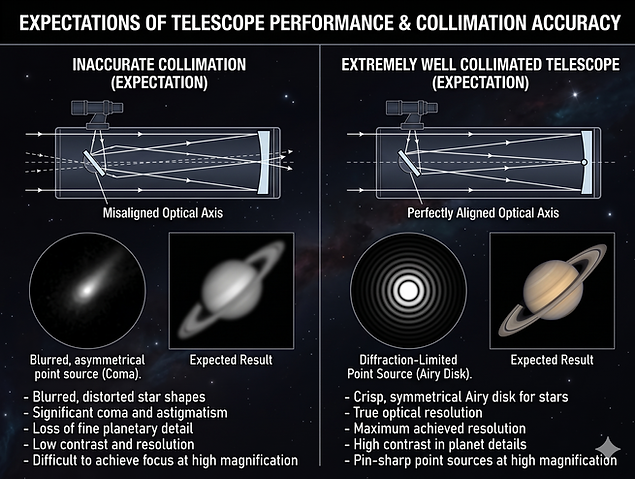
The collimation (alignment) of a telescope's mirrors is extremely important for visual observation. For very fast visual telescopes (focal ratio < 5) and telescopes used for astrophotography, collimation becomes critical.
Traditional Cheshire eyepieces are quite subjective, making collimation a challenge, as they cannot achieve the precision required for astrophotography or relatively fast telescopes.
The innovative Skylabs Cheshire Eyepiece enables the precise alignment of the optical axes of the primary and secondary mirrors in Schmidt-Newtonian, Maksutov-Newtonian, and Newtonian telescopes with unprecedented accuracy.
How to Use a Bahtinov Mask

How does it work?
The reflective Cheshire eyepiece relies on a perfectly centered reflective spot on the Newtonian telescope's primary mirror and a reflective circle at the eyepiece's edge. The circle's image reflects multiple times between the telescope's mirrors, enabling exceptionally precise and objective collimation.
Single-beam laser collimators are affordable and user-friendly but cannot correct the secondary mirror's off-axis position or verify both mirrors' alignment. While lasers expedite the process, a Cheshire eyepiece remains essential for achieving perfect mirror collimation.
Most Newtonian telescopes feature a center-marked donut or triangle on the primary mirror. If yours lacks one, Skylabs' mirror spotting template and center spots are crucial. Select the correct size: the small triangle for 1.25" Cheshires or the larger one for 2" models. A 2" Cheshire is strongly recommended if your focuser is 2".

Compatibility & Filter Recommendations
The Skylabs Enhanced Bahtinov masks are designed to work with the most popular square filter systems, including Haida, NiSi, Lee, K&F Concept, Cokin, Benro, and Formatt-Hitech, making them versatile across a wide range of lens sizes.
If you don’t already own a square filter holder, we recommend the 100mm option as the standard choice for broad compatibility. The 85mm version may limit compatibility with larger lenses, while the 150mm format is ideal for ultra-wide-angle lenses.
Optimal Performance Tips
For the best results, the Skylabs Enhanced Bahtinov mask excels with bright lenses (low f-number). As the f-number increases, the diffraction pattern becomes less visible, requiring longer exposures. To evaluate focus accurately:
-
Use a high ISO setting.
-
Avoid stopping down the lens during focus checks.
For short focal lengths (<14mm) and high f-numbers (>f/2.8), aim at a bright star or a distant light source beyond the hyperfocal distance. Alternatively, create an artificial star by covering a torch with foil and poking a small pinhole in the center.

Lesser-Known Benefits
Diagnosing Lens Focus Issues
Some lenses struggle to achieve perfect infinity focus, but this can be difficult to verify objectively. A Bahtinov mask provides a precise way to test your lens’s focus capability. By analyzing the diffraction pattern, you can determine whether your lens has a focus calibration problem.
Precision Focus Calibration
Manually calibrating infinity focus can be challenging. With a Bahtinov mask, you can fine-tune your lens’s infinity focus point and improve your focus accuracy for daytime photography.
Compensating for Focus Shift (Thermal & Mechanical)
Some lenses experience focus drift over time, and temperature changes can even alter infinity focus mid-session. A Bahtinov mask allows you to detect and correct these shifts, ensuring consistent sharpness throughout your shoot, whether you’re working in freezing night conditions or dealing with lens wear over years of use.
Documentation and FAQs
Documentation
-
Skylabs Enhanced Bahtinov mask documentation PDF [145kb].
-
Comparing different focusing masks for camera lenses - official blog.
FAQs
-
My diffraction pattern is too faint. What’s wrong?
1. Use a brighter star (e.g., Vega, Sirius) or artificial star.
2. Open your lens to its widest aperture (low f-number).
3. Increase ISO temporarily while focusing.
4. Avoid light pollution or haze. -
Why use a Bahtinov Mask instead of autofocus or Live View?
More precise than autofocus (which often fails in low light).
More reliable than Live View magnification (which can be subjective).
Works even with manual lenses (no electronic focus required). -
How to clean this mask?
Use the standard approach as other photographic filters.
1. Remove loose dust first with a blower bulb or compressed air.
2. Apply a mild cleaning solution by dampen a microfiber cloth with distilled water or isopropyl alcohol (70% or less).
3. Wipe gently in one direction. Use light pressure.
4. Air Dry or Use a Dry Microfiber -
Why did the price change in the final checkout?
We are a New Zealand company, and the final price is set in New Zealand Dollars.